Showing posts with label Services. Show all posts

Tuesday, November 26, 2013

Hunger and the Holidays

Although we haven’t yet celebrated Thanksgiving, we are already being surrounded by the sights and sounds of Christmas. Music, advertising, decorations, gift guides; even the Salvation Army has begun its preparation for Christmas. From Angel Tree registration to Bell Ringing schedules and much more, we are well in the midst of our favorite season.


But what about those for whom the holidays aren’t that special: The homeless man crossing the street in the bustle of holiday shoppers; the mother in the grocery store among shoppers buying holiday specialties, while she cannot afford a loaf of bread or a jug of milk?
It is heart breaking to hear stories of Daniel, a single father of a 10-year-old boy who has been struggling since he lost his executive level job. He tells us he has no money and no food and that his electricity will soon be turned off. He is worried his son will spend Christmas sitting in a cold, dark house.

For Daniel, and thousands of families in our community struggling through personal economic crisis, hunger is a dark shadow, always looming. And during this festive Christmas season, it is even harder. Will this be the Christmas where there is no tree, no special dinner, no presents?
But you CAN help. You CAN hold a CANNED food drive to help stock the pantry of The Salvation Army so we can provide a basket of food to Daniel and the thousands of families who will come through our doors to receive Angel Tree gifts. Whether it is at your business, your church, your child’s school or even at your family’s Thanksgiving gathering, anything helps.

Or, you CAN hold your own private drive!

Help us turn this.....                                         

 .... into THIS!


It’s easy! As you go about shopping for Thanksgiving, your Christmas season dinners and parties or just your typical grocery shopping, pick up something extra. We need canned, non-perishable goods and we while we won’t be picky, we especially need canned vegetables, beans, pumpkin, fruit, soup and peanut butter.

Then, bring those cans of food to the west entrance of The Salvation Army Joy Center, 924 S. Hudson, between 9 a.m. and 4 p.m., Monday through Friday, (not Nov. 28 or 29!) through Dec. 6, you’ll be putting a little more “merry” into someone’s Christmas.

-DJ


Thursday, September 12, 2013

Free Wifi For the Homeless!

I’m excited to write this blog because it has been a long time coming.  
It all started last fall, when the Tulsa Area United Way got a large donation of used laptops from local business, Hilti and set up an application process for agencies like ours to get them.  We were lucky enough to get 40 to use at our Center of Hope.  This left us with a bit of a problem though, the laptops needed wi-fi for our clients to check them out and use them but the only wi-fi we had at the facility was in our administrative area and wasn’t set up as a public network.

This spurred us into action and we asked for a grant to cover the cost to do all the “techy” things needed to turn a 70,000 sq/ft. building into  a hot spot for guests.  Thankfully, The Salvation Army Women’s Auxiliary provided the funds needed.  As we were ironing out the security features, our guests could see the public network appearing on their devices and they started getting excited! Questions flowed to our staff about what the guest network was and when it would be available.


During the first week we had the wi-fi available (with no promotion/signage at all) we had an average of about 100 guests a night utilizing the network.  This may be very surprising to some, but many of the guests staying at the shelter keep mobile phones for necessary contact with work and family but they cannot afford the data packages required to surf the internet via a mobile device. Our main overnight population is required to stay in the facility after check-in which means that from 6p.m. to 6a.m. they haven’t had access to email, web, news, etc.  Now they can spend that time looking for housing, completing schoolwork, playing games to pass the time and communicating with family and friends. 

We are currently soliciting funding to expand the technology program at the Center by building an on-site computer lab. This lab would be accessible to all clients with designated hours for after-school homework time. Besides general internet access and other basic functions, clients will also have the opportunity to enroll in useful courses, taught by community volunteers and Center of Hope staff.

I hope you can share in my excitement! We are so proud to be the first shelter in Tulsa offering this service.  It improves the quality of life for many and gives them something that we all take for granted! 


-Lindsay 

Monday, July 1, 2013

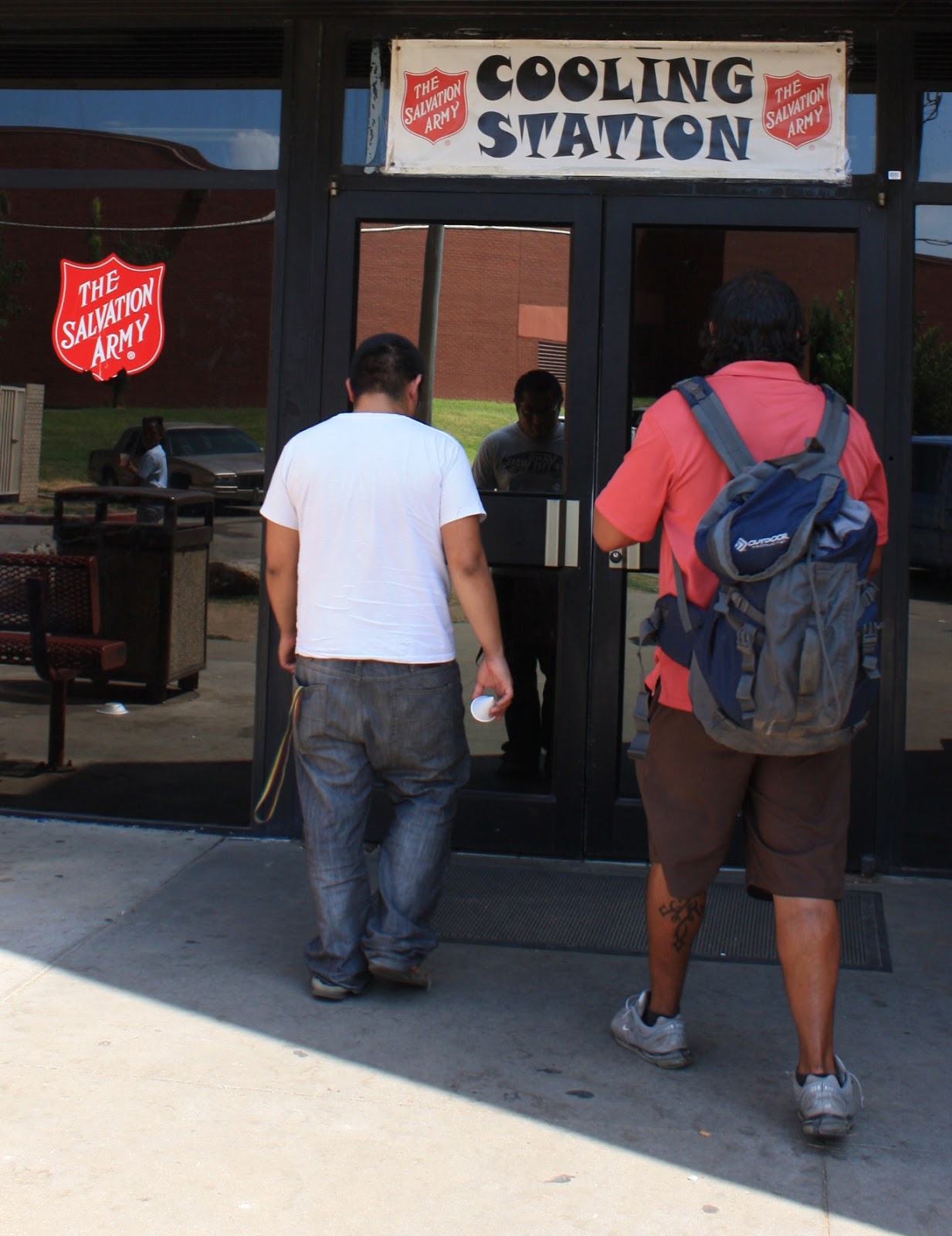
Salvation Army helps people stay cool

Home Energy Aid Month raises money to help people pay for utilities

The Salvation Army has many programs that can make a huge impact on people’s lives. One of my favorites is Emergency Financial Assistance (EFA), which helps those who are facing financial challenges pay their utility bills.  We consider this a homeless prevention program.  It’s even got the attention of Mayor Dewey Barlett and Governor Mary Fallin who have declared July Home Energy Aid Month in Tulsa and the State of Oklahoma.

Home Energy Aid Month raises awareness of the program while helping us get more donations to ensure we can help everyone who needs it.  During the summer months, the funds we have to run this program start running low.  Some people have to choose between paying their gas/electric bill or their rent or food.  Each household can only receive assistance one time per year so the assistance does not create dependency, only offers them a hand up. The Salvation Army never pays all of the bill either, the customer must pay some of it.

EFA is funded primarily by donations to Public Service Company of Oklahoma’s Light A Life program, Oklahoma Natural Gas Company’s Share the Warmth program and Oklahoma Gas & Electric Company’s Lend A Hand program. We have several events planned for HEA Month including:


 *Bean Chowder Chowdown – Thursday, July 18th, 11am-1pm - For the second year in a row, the Center of Hope (102 N. Denver) will host the Bean Chowder Chowdown. For $7, people can get a bowl of bean chowder (recipe made famou sby Tulsa Public Schools), plus cornbread and a drink. Cinnamon rolls will also be available for an additional fee. This year, we are encouraging people to order take-out to get more businesses to buy for a group of people.

*PSO & Shock Partnership - July 19th, 21st & 25th – The Shock and PSO will hold various activities and fundraisers throughout these games to bring awareness to PSO’s Light A Life program and  Home Energy Aid Month. PSO is also providing 150 tickets to Boys & Girls Clubs members to the 25th game.

*Westlake Fan Discounts – The three Tulsa Westlake Hardware stores will donate several dozen box fans to The Salvation Army and hopes its customers will do the same. Westlake is offering discounted box fans for $16.99 in their stores for customers to buy and donate to us The promotion will run July 1-14.


-Carrie


Wednesday, June 26, 2013

Volunteer coordinator helps in aftermath of tornadoes

Jenny shot this amazing photo.

Tulsa Salvation Army staffer plays critical role in recovery

When Volunteer Coordinator Jenny McElyea taught her most recent disaster training class, she had no idea that within a few weeks she would be working in her first disaster, much less recruiting and processing hundreds of volunteers in the aftermath of tornadoes. When she arrived in Oklahoma City on May 31st, she also had no idea that by 1 a.m. she’d be sitting in the stairwell of the Arkansas Oklahoma Salvation Army Headquarters, waiting out tornadoes in El Reno.

“Factors are changing constantly. There’s change at a moment’s notice. You have to be willing and be flexible,” Jenny said recently. As soon as she arrived in OKC, she was named as Incident Command Volunteer Coordinator. “Originally they thought they’d have to find someone from out of state to take the position,” she said. “So they were glad to find me. I was honored to be chosen.”
Jenny is on the far right in this photo from Incident Command.

Although volunteers were plentiful immediately after the May 20 tornado in Moore, by the time Jenny arrived, interest in volunteering was waning, especially interest in volunteering during working hours. So she put out the word by utilizing special website for people to sign up and using social media.

The largest site she was responsible for filling with volunteers was the old JCPenney at the Plaza de Mayor Mall, where donated items such as bottled water and cleaning supplies were collected. Volunteers sorted the donated goods and helped tornado victims “shop” the aisles for items they could use.

Jenny also found volunteers for MARCS, Multi Agency Resource Centers, where volunteers and social works helped tornado victims fill out the necessary paperwork to apply for aid. And when the combination of on line and social media volunteer recruitment didn’t seem to be enough to get those workday volunteers, Jenny turned to old fashioned techniques, ones that were in abundance during the tornadoes and the aftermath.

“I prayed and I cried,” she said.
By all accounts, Jenny’s first disaster experience was a success.

-Sallie


Tuesday, June 18, 2013

Passport to Manhood

Jamar Giddings is second from right.

Salvation Army Boys and Girls Club's special program popular


What does "manhood" mean to today's youth? For many boys in West Tulsa, it means toying with dropping out of school early, seeking friendship and leadership in gangs, and experimenting with drugs.

But one man is setting a different example. West Tulsa Boys & Girls Club director, Jamar Giddings, is a mentor and friend to many young men, welcoming them into his Club, but also his home.
For the past several years, Jamar (who we last saw at the Youth of the Year awards banquet with the 2013 Youth of the Year Anthony Wilson) has lead a program called "Passport to Manhood" and supplemented the lessons of the program with lots of one-on-one time, modeling fatherhood and manhood at his home and with his church family.


Passport to Manhood teaches a variety of basic life skills and lessons cover topics like:
  • banking and checking/savings accounts
  • hygiene
  • job skills/resume
  • self-esteem
  • etiquette
  • relationships/girls/respect, etc.

Caleb Green
The Boys & Girls Club curriculum can be tailored to a specific age group audience, which is generally either Elementary/Middle School (ages 8-12) or Middle/High School (13-18).


In addition to 'lessons' and one-on-one time, Jamar has been good to engage community members to come speak to the Passport guys. He's drawn from a variety of professions, from international sports professionals like Kelvin Sangel and Caleb Green, to Club alumni who are lawyers and bankers, like Lee Jones, formerly with BOK.
Jamar Giddings playing basketball.

~~~~~~~~~~~~
Unfortunately, the curriculum that West Mabee has to work with is outdated (last purchased in 1999) and with new curriculum available, Jamar is hoping to relaunch the Passport to Manhood program and reach more boys than ever before. 

We hope to help him; just last week, I applied for a Passport to Manhood grant for all new curriculum and a program assistant. We won't hear back on the application for a few months, but we are moving forward with a basketball tournament with players from ORU to get kids over to the Club, and hopefully, get them on the right track to true manhood.

 ~~~~~~~~~~~~~~~~~~~~~

If you would like to support Jamar's efforts to teach young men the art of being a man, you can call The Salvation Army Tulsa Area Command at 918-587-7801 to make a donation or donate online at: http://salarmytulsa.org/Home.

If you would be interested in speaking to a Passport to Manhood group on your area of expertise, call us! We would love to put you in touch with Jamar.

Please share this post with friends or family who may be interested in the program or in supporting the program!

-Vicki


Wednesday, June 12, 2013

"The Salvation Army Saved My Life"

How the Salvation Army Made a Difference to a former multi-millionaire.

 I first heard Lyle's personal story at a United Way tour through the Center of Hope; I was astonished by his story of loss, recovery and hope and wanted to share it with you.

Lyle Lawrence has a strong handshake, makes good eye contact & talks easily when you meet him. He is an experienced businessman & salesperson, and currently, a Center of Hope resident. Although Lyle once retired at the age of 36 with a net worth of 3.5 million dollars, he now shares a room with a fellow homeless substance abuser in recovery. How did he get here? Alcoholism. 

Lyle credit’s the Salvation Army with saving his life. Although he developed alcoholism late in life, it didn’t take him long after his retirement at the age of 36 to drink, gamble and smoke his savings away. He was broke by 47. And sleeping in his car shortly thereafter.   

But he had further to fall.

Friday, June 7, 2013

Supporting Little Axe with presence and prayer

The Salvation Army mobilized to help hard-hit areas

On the evening of Sunday May 19, tornadoes damaged hundreds of homes in Shawnee, Newcastle, Carney and Little Axe..  The Salvation Army responded immediately with food, hydration and emotional and spiritual care.  The very next afternoon the unimaginable happened. An F5 tornado, nearly four miles wide in some places, dropped only 25 miles away from Sunday’s damage, in Moore.

Many of the national emergency organizations that had been in Shawnee and Little Axe immediately left, heading to the area of greater damage on the other side of Oklahoma City.  The Salvation Army was one of those agencies that had to pull out, but it was only temporary. By Tuesday afternoon more mobile feeding units and staff had been mobilized and care of the lesser-hit (but still devastated) areas resumed.  I visited one of these areas, Little Axe, on Wed., May 29, ten days after this small town lost so many homes.

My guides for the day were  Major Marion Durham, Captain Chris Farrell and Lieutenant Michael Missey, Emotional and Spiritual Care (ESC) counselors, all of whom traveled from Florida to help Oklahomans. This was their seventh day on the ground in the Little Axe community and most of the homes we visited were repeat visits; daily check-ins to offer water, ice, Gatorade, snacks and spiritual care.

The Little Axe community was devastated;  many of the homes impacted were mobile homes with lightweight walls, no foundation and roofs with very little support.  The tornado made a great impact on these rural homes, spreading debris across pastures and up and down red dirt roads, all through the area’s hills and valleys.

The ESC team knew each homeowner by name. As we pulled up, Major Durham would give me an overview of the family’s situation.  Many were still trying to get access to basic needs, others were on the road to recovery, but all were just trying to clear the debris from their land while simultaneously planning to rebuild.
Major Durham visits with Robert near Little Axe, Okla.
When we pulled up to the home of a man named Robert, it didn’t look like anyone was home.  The mobile home looked almost untouched from the front yard, but I knew there was more than met the eye based on the large pile of debris by the curb.  We unloaded and headed to the back of the lot where you could see the back half of the home was completely missing.  We spotted Robert feeding his chickens and said hello while he updated the team on his family’s situation. He was angry; the insurance agency had offered his family less than what he owed for his home and the land it sat upon. Using “colorful” language, Robert shared his feelings with the team and they did what they have been trained to do, listened.

He was frustrated that looting was becoming  a problem along his country road.  Although all of his metal debris, appliances, lawn mowers, etc. had been earmarked for the city to pick up and sell for money that would benefit his community, others kept coming by and trying to take it.  “It’s spoken for,” he related angrily to us.  Just because these items were damaged and piled in the front yard, he was still the owner and felt violated when others stopped and started rifling through his belongings. “People can be real mean at times and real helpful at times,” he said.

Wednesday, May 22, 2013

Collections for tornado victims continue

Tulsans help The Salvation Army Tulsa Area Command by donating items for tornado victims
 

Tulsans helped tornado victims by donating needed items to The Salvation Army (TSA) Tulsa Area Command Tuesday and the collection effort will continue today and tomorrow. The Tulsa Area Command is collecting hydration items, snacks and toiletries to give to people in Moore who are helping with recovery. 

Tulsa Area Command will collect items listed below today from 10 a.m. to 4:30 p.m. and from noon to 4:30p.m. Thursday and Friday in the west parking lot of their headquarters at 924 S. Hudson.

Reasor’s Foods grocery stores will also collect the below items to give to The Salvation Army for tornado recovery in Moore. Reasor’s also will match up to $10,000 of donations made when people text STORM to 80888 to donate $10 to The Salvation Army for tornado relief. 


Items Needed for Tornado Recovery:
Bottled water
Gatorade
Wet Wipes
Individually wrapped snacks
Hand sanitizer
Work gloves
Sunscreen
Heavy duty trash bags
Personal sanitation items, toothpaste, toothbrushes, shampoo, conditioner, deodorant.

NO CLOTHING DONATIONS ARE NEEDED AT THIS TIME. Storage is limited and must be used for immediate needs. Cash donations are preferred, as the funds can be used immediately where there is the greatest. All items will be used for disaster victims locally.

How to help:
TEXT TO GIVE by texting STORM to 80888 for a $10 donation

 
DONATE BY MAIL
The Salvation Army Disaster Relief
P.O. BOX 12600
Oklahoma City, OK 73157
Please designate Oklahoma Tornado Relief on all checks.

DONATE BY PHONE
1-800-SAL-ARMY
(1-800-725-2769)

DONATE ONLINE
https://donate.salvationarmyusa.org/uss/eds/aok


Monday, May 13, 2013

Celebrate Salvation Army Week by learning more about Boys & Girls Clubs!

What does The Salvation Army mean to kids and parents?
Roylee and his grandmother
This is Salvation Army Week and people are celebrating around the world.  At The Salvation Army Tulsa Area Command, one of the ways we are celebrating is to learn more about what The Salvation Army means to different people who use our services, volunteer with us or who are affected by The Savlation Army in other ways.

Friday,  I was at the Mabee Red Shield Boys & Girls Club for two events; the grand opening of their Cox Technology Center and  their Mothers Day Tea, so I got a chance to ask club members, their moms and grandmas about what the Mabee Red Shield Boys & Girls Club means to them.

“It does mean a lot,” Roylee, age 10 told me. “They call me out on stuff, help me with my homework, keep me active and give me a program. They are always nice,” he said. I think it says a lot that Roylee recognizes that getting “called out on stuff” is a positive thing. Any parent who wants to be “friends” with their child  take note!

Roylee’s grandmother, Sandra Gunnells, looks after Roylee’s younger siblings while he is at the club’s aftercare program and picks Roylee up every weekday. “Mabee Red Shield provides an outlet for Roylee. He can be rough and tough playing football and during baseball he pops, bats, runs and catches. It’s two different sports that develop different skills and keep him active,” Sandra said. She is also appreciative of the hygiene tips Roylee has picked up. “No more stinky pits,” is the way this down-to-earth grandma put it.
Brooklyn

Brooklyn, age nine, is in the third grade at Lanier Elementary. She said she was surprised by the number of members (250) and Mabee Red Shield’s Boy Scout troop. She also was surprised by all the art activities when she first started at Mabee Red Shield. “ I like coming here and taking the art class. I like to draw and my favorite is drawing funny people,” Brooklyn said.

When I first saw Brooklyn at the club Friday I thought she was in a time out because she was seated by herself in the game room and was wearing a pout. I asked her about it. "No, I was feeling sad because I was missing my mom," she said. I think it's great that our Program Aides let Brooklyn take time out from activities to feel her feelings without being scolded or made fun of by the other kids.

Three people, three different views of what The Salvation Army means to them. We can’t be all things to all people, and don’t even try to be. But what we do, we do well, and helping children grow into adults is one of those things. -Sallie


Friday, April 5, 2013

Yes, people live there....

Toddlers at the Center of Hope
Thousands of people pass by our Center of Hope every day. The downtown facility is well known as an emergency shelter and place to get a hot meal. What most people don’t know is that there are actually families who live at our shelter. This program is called Supportive Housing and according to Supportive Housing Case Manager Kelley Maricle, it helps families who are willing to work toward self-sufficiency through case management, education and life skills training. The Center of Hope has 17 apartments for families in this program.

Center of Hope birthday party
Can you imagine if your life went off track in such a way that you ended up on the streets with your children with nowhere to turn? What if someone offered you a key to an apartment and the tools you needed to get back on your feet at no cost? That is exactly what this program does. The families in the program have to take it seriously and abide by all the rules but if they do, we can offer them a path to a brighter future.


What exactly does the program do? The program gives families—parent(s) with one or more children—a furnished apartment to call “home” while they address the issues that led to them becoming homeless. For some it is debt and poor money management, for others it may be a lack of job skills or training; there are many reasons that families seek out our help. Those in our program can stay in their apartment for up to two years while they attend weekly life skills classes where they learn budgeting, ethics, parenting and job hunting skills and much, much more. They also meet routinely with a skilled social worker to review their progress and ensure they stay on track.
There's a girl behind the flamingo!
This program helps families and residents all work together to make their time in the program enjoyable. Our staff helps them celebrate birthdays and holidays, but during my conversation with Kelley, she told me the families are always interested in doing more.
“They wish they could have cookouts and makeover nights, parent’s nights out and things like that.”   Unfortunately, the program funds don’t stretch that far so we are always looking for volunteers to help our families by offering their time and resources.
This program really does ensure The Salvation Army is Doing the Most Good; participants from our program leave ready to maintain their permanent housing with the skills they have learned during the time spent with us. If you would like to find out how you can volunteer with these families, call Jenny 918-587-7801.

-Lindsay

Tuesday, March 26, 2013

Salvation Army Easter Services


Easter is here already, can you believe it? It seems like yesterday I was writing a post about Christmas. How do you celebrate Easter -- by hunting brightly colored eggs, eating the ears off of chocolate bunnies, going to church? Maybe all three?  No matter how you celebrate Easter, have you thought about what Easter is or even how in the world the Easter bunny lays eggs?

Let’s start with the easy one first. Easter is the holiday we celebrate the resurrection of Jesus on the third day after his crucifixion. Okay, now for the slightly harder question, how did an egg-laying bunny come into play? Well, the first mention of Oschter Haws  (i.e the Easter Bunny) was mentioned in German writings back in the 1600s. Oschter Haws is a rabbit that lays a nest full of brightly colored eggs and candy for good boys and girls. The idea of Oschter Haws was brought to America in the 1700 by Dutch settlers.


Rabbits are known for their fertility especially during the spring (when we celebrate Easter) and eggs have been regarded as a symbol of new life since early Roman times. Put them both together and you have the Easter Bunny. A symbolic representation of the new life we have through Christ who died but rose again.

If you are looking for a church service or maybe a lovely Easter lunch then please consider joining us at one of our Corps.

Tulsa Citadel- 3901 East 28th Street, Tulsa.  Sunday School 10a.m., Morning Services 11a.m.

Center of Hope-102 North Denver Ave, Tulsa.  Easter Lunch 11a.m. -2 p.m., Evening Service 6:30 p.m.

Broken Arrow Corps- 1400 West Washington, Broken Arrow. Sunday School 9:45 a.m., Morning Services 11 a.m.

Sand Springs Corps-4403 South 129th West Avenue, Sand Springs.  Breakfast and fellowship 9:15 a.m., Sunday School 10 a.m., Morning Service 11a.m.


-Jenny


Monday, March 11, 2013

5 Things You Don't Know About the Broken Arrow B&GClub

A few weeks ago, I went to visit the Boys & Girls Club down in Broken Arrow. I was familiar by sight with the Club, since I got married at Tarp Chapel across the street, lo these 5+ years ago.

Anyway, I met with longtime Club Director, Janis Fraley to pick her brain a little bit about grant-related needs and then got a grand tour of her Club. 

Here are five things that I learned about what makes the Boys and Girls Club of Broken Arrow wonderful and unique.

1. In addition to more traditional team sports like basketball and baseball, they Club is also home to an active karate program. And Ms. Janis has been teaching karate for more than 25 years!

Swimming = happy Club kids!
2. The Club's indoor swimming pool hosts Club open swim, community water aerobics, oh and, practices for the Broken Arrow High School varsity swim team.

3. Boy Scout Troop 995 meets at the Club every month and there are a LOT of Eagle Scout projects beautifying the Club property-- they've built picnic tables, sand boxes, and even outdoor decks for the Club kids use! 

4. Janis knows how to line up the support. When I visited, they were about a week out from the recent Bouncin' BBQ and had silent auction baskets stacked from floor to ceiling! Add to all those donated items, the recently donated desks and chairs from Ferguson Pontiac there in Broken Arrow, Janis' Club was chock full of community support!

Swinging = happy Challenger kids!
5. Lastly, the BA Club is known for miles around for their Challenger programs designed for "differently abled" children and youth. More than 150 physically and/or mentally challenged kids play team sports on the "Challenger" baseball field, play on the wheelchair accessible swings and lap the fields on the Challenger Walk.

Pretty cool, huh? 
~~~~
If have an interest in helping out at this great Club, you could volunteer your time or resources at the Club itself; contact Jenny McElyea Volunteer Coordinator at 918-587-7801

 Also, Teen area could use 2 new couches--teens sure are hard on furniture, aren't they? 

And lastly, Janis is collecting sponsors for Phase III of the Challenger Walk/Playground Expansion! Contact her directly for more information about this opportunity; 918-258-7545.
~~~~

Rock on, BA! I'm impressed and inspired by what all you have going on at your amazing Club!
~Vicki

Saturday, March 2, 2013

We need your old stuff!

Reggie Kelly, one of the
many men helped by the
Family Stores
Did you know that every time you donate your old clothes, furniture and collectibles to The Salvation Army we turn it into life-changing programs?

We offer a 180-day residential program for men that may be in need of assistance successfully re-entering society. Our program is Christian based and provides instruction and activities focusing on learning skills that allow participants to gain insights into their problems.We use a Christian 12 Step recovery program called "Celebrate Recovery!" as curriculum, in addition to the Bible. Residents acquire self-respect, and develop moral and spiritual principles that will enable them to gain purpose and meaning in their lives.  Although the program is not exclusive to men with substance abuse/addiction problems, they do constitute a majority of the residents.To learn how ARC helped a recovering addict click here.
Our warehouse shelves are empty, your donations are needed!

Each ARC offers residential housing, work in our stores and processing donated items, and group and individual therapy, all in a clean, wholesome environment. The physical and spiritual care that program participants receive prepares them to re-enter society and return to gainful employment. Many of those who have been rehabilitated are also reunited with their families.


The only source of funding for this 3.5 million dollar program is through the sale of donated usable items in our Family Stores located at 11523 E. 31st St. Tulsa and 4700 W. Kenosha St. Broken Arrow.

WE DESPERATELY NEED DONATIONS OF USABLE ITEMS, our shelves are bare. These items may be dropped off at our two store locations or at our Processing Center directly behind our Main Center located at 601 N. Main St. Tulsa, Ok. We are also happy to schedule an appointment to pick up items at your home. You can call us at 1-800-SATRUCK. (1-800-728-7825) or by going to tulsa.satruck.org.There you can also see a list of items we are not able to take by selecting “Schedule a Pickup” We thank you for your support.

May God bless you.

Major Tom Overton


Wednesday, February 27, 2013

Learning LifeSkills for a Better Life

Recently, I visited The Center of Hope in downtown Tulsa to chat with some of our caseworkers about some of the longer term housing programs that we have for homeless families and individuals, in addition to the nightly housing and meals available to the general public.

We also talked about the LifeSkills classes that clients in the supportive and transitional programs attend-- this is different from the "Pathways" classes for the general population in the Center's overnight shelter. The main difference is that the LifeSkills classes are actually tailored to address needs and concerns of program participants.

Program participants in the Supportive Housing Program (SHP) for homeless families, and in Project Able, our substance abuse recovery program, will typically participate in LifeSkills for year or more. In fact, the average length of stay for SHP participants is 456 days (or a year and 3 months); and for Project Able clients, it's 593 days (or a year & 7 months)*.

Topics in the LifeSkills classes tend to be focused on addressing issues that contributed to homelessness for the clients, in order to increase their knowledge and coping ability, so that they can remain housed after they leave our program.

For example, recent classes include:
  • Housing- How to find an apartment
  • How to open/ keep a bank account
  • Credit Scores 101
  • Examining Paradigms and Perceptions

In addition, LifeSkills classes have also been structured around book studies/curricula. Past book studies have included:
Financial Peace University by Dave Ramsey
and
The 7 Habits of Highly Effective People by Steven Covey.


If you are interested in contributing to the LifeSkills classes, through a donation of either time or resources, contact the Center of Hope at 918-582-7201.

--Vicki


* statistics taken from 2012 HUD APRs


Tuesday, February 5, 2013

3 Reasons why we love United Way

Recently, I faced the largest single grant application in my tenure at Salvation Army (all 6 months of it). Not in size, no, but in grant request amount. 

I tackled the mountain of (metaphorical) paperwork (it's an electronic application) that is the annual Tulsa Area United Way (TAUW) Request for Funding. The application for 2014 funding was a beast- it included financial information, detailed information about our Advisory Board, as well as reporting on all 6 of our United Way funded projects, IN ADDITION TO the actual agency request for funding. 

Due to some scheduling issues, I ended up only having about a week to work on the application/report, whereas most other agencies have been crafting their application since mid-Decemeber.We were a little busy around here.  :)

You may be wondering, why is the United Way application such a big deal? and why its well worth the effort? Well, three main reasons:

Key support for programs:
The United Way is a key component of the financial stability of our major programs; annually, between 13 and 15% of the overall agency budget comes from United Way funding. The 6 major programs that TAUW funding supports are:
  1. Boys and Girls Clubs of Metro Tulsa- neighborhood clubs offering academic, sport and social programming for lower income youth, ages 5-18.
    • North Mabee
    • Mabee Red Shield
    • Sand Springs
    • Sapulpa
    • Broken Arrow
  2. Community Centers- adult health and educational programming offered at each area Boys and Girls Club.
  3. Emergency Shelter- Northeast Oklahoma's largest overnight shelter with a capacity of 350, serving 3 meals a day for guests and a public dinner meal nightly
  4.  Emergency Financial Assistance- a homeless prevention and financial aid program for utilities, medical and other essential service
  5. Supportive Housing Program- a transitional housing program for homeless families
  6. Project Able- a permanent housing program for recovering substance addicts.

Community support
In addition, being part of the United Way is important to The Salvation Army because of the connections that it brings to other agencies- to avoid duplication of services as well as to form partnerships and make referrals in the event that our programs are not a good fit for clients seeking assistance- and connections that the public can have with us as a result.

One of our favorite events during the year is the annual Day of Caring. Day of Caring, to me, is mind-blowing for it's coordination and for the sheer number of people, from different companies across Green Country.

From TAUW Fast Facts:
The Tulsa Area United Way Day of Caring is one of the largest such events in the nation, with 4,125 volunteers completing more than 33,000 hours of work at area parks, schools and non-profit organizations.

2012's Day of Caring was a great experience: we had over 300 volunteers working for The Salvation Army. And those volunteers undertook more than 30 different projects at our various locations and volunteered for a total of 1,280 hours!

Volunteers lay flooring for a storage building at the BA Boys and Girls Club.

As volunteer coordinator Jenny McElyea said in her Day of Caring blog post,

"The great thing about Day of Caring is that it’s a perfect testament to what people can do when they work together!  This year projects ranged from a cook-out for the guests at the Center of Hope courtesy of Mazzio's to the cleaning of the fence line at the Sapulpa Boys and Girls club, courtesy of the Williams Companies."

Volunteers from ONEOK paint a new picnic table they bought for the North Mabee club.
We are looking forward to attending the "Live United" Awards Banquet next week, where top companies and organizations will be recognized for their volunteer and monetary contributions to this year's campaign (the largest in TAUW history!). We love being a part of the success of the annual United Way campaign, not just as recipients of funds, but as donors ourselves.

Donor Confidence
Lastly, we really value being a United Way member agency because of the confidence that it gives our donors. As a United Way agency, we are held to some pretty rigorous financial standards and must submit our financials every year upon application for funds. Of the hundreds of non-profit organizations in the Tulsa area, only 60 are Tulsa Area United Way member organizations.

After we, the agencies, submit our applications in January, review panels are assembled and conduct assessments.  
"The Panels conduct in-depth assessments of each agency according to the following criteria: community need, program effectiveness, fiscal and administrative strength and additional resources leveraged by the agency. The panels hold several meetings during the spring to study agency applications for funding. In addition, a separate, independent Audit Committee pours over each agency's financial statements.
After reviewing the applications, panel members participate in site visits of each agency, followed by conferences with agency staff. Finally, the panels recommend funding for each agency, including their rationale, and funding priorities within and between agencies."


Not only do United Way donors benefit from this process, in knowing that each agency is closely assessed, but so do our Salvation Army donors.  Our accounting processes are efficient and our overall budget benefit from the stability of a regular deposits from the TAUW.


You can find out more about the TAUW's fiscal responsibility here.

Hope you've learned something new about the United Way and feel proud to be part of community that so enthusiastically supports non-profit work!

 -Vicki

p.s. Check out the 2012 campaign video, it's great!


Friday, February 1, 2013

EFA program popular as ever

EFA interview room
I just don’t know how they do it. I was at the Center of Hope this week with a Tulsa World reporter and photographer. They were covering our Emergency Financial Assistance (EFA) program because for the fourth year in a row the 211 social services line has referred more people to EFA than any other program. EFA helps prevent homelessness by helping people pay their utility bills and sometimes other bills. Case manager Cathy Kumm coordinates the program and clerk Heather Houston assists.
EFA Case Manager Cathy Kumm

People who need assistance call the Center of Hope and make an appointment for EFA. After checking applicants’ paperwork, Cathy and Heather call the utility companies and negotiate. They often get part of the bill reduced, then tell applicants about other agencies which can help with the rest of the bill.That means Cathy and Heather listen to the applicants’ sad stories, four days a week, a couple of hours a day.  You can read more detail about the process here.

I’ve listened to some sad stories myself and I don’t know how Cathy and Heather do it. Today I heard the story of a 69-year-old widow who was conned by a man her age who wanted to be her boyfriend.  She left her cozy apartment and moved into his house with him.

EFA Clerk Heather Houston
When she became sick with breast cancer and had to have a radical mastectomy, he lost interest, moved out, took her car and shut off the electricity in his house. She ended up with overwhelming bills. Thankfully, she has a good support network of longtime friends who found her a vehicle and bring her food. I imagine that’s not the worst story told during EFA interviews, but it left me feeling drained. It’s a tough job that they do and I hope they know how appreciated they are.  


-Sallie

Wednesday, October 24, 2012

United Way, helping with more than $$$

We’re right in the middle of the Tulsa Area United Way campaign, which helps more than 60 non-profit organizations throughout Tulsa. Our community is fortunate that there are so many groups trying to help as many people as possible. Recently, I got to work with five of these organizations to see how we can focus on reaching the needs of Tulsa’s youth.

The United Way provided cohort training from the Center for What Works.  The cohort groups included the Salvation Army Boys & Girls Clubs of Metro Tulsa, Girl Scouts of Eastern Oklahoma, Youth at Heart, Campfire USA Green Country Council, Operation Aware and the Indian Nations Council Boy Scouts of America. Leaders from all of these groups met once a month for nine months to discuss how we go from “provider” to “performance.” Each group picked a program provided locally to support youth and then we learned steps we could take to improve upon the work we are doing. 

The Boys & Girls Clubs are working on their Healthy Habits program, which provides education and hands on activities to ensure kids (and their families) lead healthier lives.  Teenagers from one of our Clubs were required to go on a hike/walk at LaFortune Park once a week.  Some of the teens would complain and skip the activity.  Staff then decided to give incentives, such as refreshments and treats. By the end of summer, everyone showed up for the walk and the teens were then good role models for the younger kids.

Another bonus of the training was getting to know leaders from these other organizations.  We all have something in common: character building our youth.  Both Boys Scouts and Girl Scouts even have meetings at our Clubs.  Operation Aware held a Fun & Fit event this summer in which the Clubs participated.  Even though the training officially ended in September, the non-profits are still meeting once a month to help each other on our progress and continue building our relationships.

Although all of Tulsa’s non-profits work to improve the lives of our citizens, we can’t do it alone. That’s why it’s important to support the United Way campaign, because the Tulsa Area United Way provides help to so many important organizations in our community, whether it be training or monetary-- they help ensure we are doing our BEST work!

-Carrie

Tuesday, September 18, 2012

Why the EFA program deserves another $20,000


Maybe it’s the grant writer in me or maybe it was the sheer volume of need I saw the day that I observed the inner workings of the Emergency Assistance Program at the Center of Hope, but I know for sure that the EFA program would easily put another twenty or heck, fifty thousand dollars to excellent use. To give an example of the volume, the 211 Helpline, the "911 number for social services" refers more callers to EFA than to any other social service program in the Tulsa area. (Read a Tulsa World article about it.)  The community members who apply to the EFA program have a direct need, a financial need, and come to the Salvation Army as an outlet of the community’s goodwill to get their need met.

Fortunately, The EFA application process is fairly straightforward. First, if a community member calls to inquire about financial assistance, they are directed to call back at 2pm to make an appointment. Appointments are made for the following business day, at 9am. At 9, applicants (of which there are usually between 20 and 40) come to see program specialists, Cathy and Heather,and fill out an application packet. The packet consists of just a few items: a photo id, the utility bill in question, verification of income (can be a current paycheck stub, DHS statement, or social security statement) and some sort of housing verification (rent receipt, lease agreement or mortgage papers). This usually takes about 15 minutes or so.

Then after packets are filled out, Cathy and Heather call each applicant up (by their folder number) and verify that they brought everything they need and to find out what their ‘story’ is -- that is, why they couldn’t pay their bill. For many, it was a matter of a fixed income and high summer bills not being compatible, for others, it's chronic unemployment. And of course, there’s always a handful of unusual circumstances: medical issues, immigration issues, and recent release from jail.
Applicants who I met ranged from families with children at home, to a great-grandmother toting a baby, to single moms, single dads, and ex-cons. Although the bills were high and the number of applicants lower, Cathy informed me that Christmas was the busiest season -- when the heating bills get big and families are trying to put together a good holiday for the kids.


Friday, September 14, 2012

4 Things You Don’t Know About Getting Financial Assistance from The Salvation Army


Recently, I left my cozy grantwriting cave, er, office at Tulsa Area Command and ventured over to our social services hub, the Center of Hope, in downtown Tulsa. I spent the morning shadowing a few different staff members as they went about their duties in the programs that we offer at the Center of Hope.  I spent the most time with the ladies who manage the day-to-day operations of the Emergency Financial Assistance program (EFA), Cathy and Heather. Cathy is a nearly 10 year Salvation Army veteran; she started working at the Center of Hope in 2003 and has been doing EFA for the past 5 years; she considers it her life work to assist families in need.


I was interested in learning about this program because I have a grant application that I’m putting together for a new funder- one that I know through my research is interested in social and community projects and has already given money to other local organizations similar to ours. And, as I was to learn, the EFA program is impressive in that it exemplifies what the Salvation Army does best: serves those in need, without discrimination.


1. Doesn’t matter who you are. The Emergency Financial Assistance program is open to everyone in need- regardless of home owner status or income. If you have a need, you can apply for assistance.

2. Helps with immediate needs. Most commonly, this looks like utility bills that are past due and/or in danger of being disconnected. You can bring your bill (along with a few other required items) and our case managers, like Cathy and Heather, will call the utility company on your behalf! (The woman pictured above didn't want us to use her name, but she was happy that we were able to help her with her untility bill!)